Case study
Deciding is the expensive part.
To decide if an idea is worth building, I build it first
Building got cheap. Knowing what to build didn't. Here's how I decide: two builds, one stopped, one rebuilt and live.
Role
Product lead. I decide what gets built.
AI builds it.
The first build
Cats of the Alley
a proof of concept
One evening
The second build
The first Job Studio
a prototype built for one user: me
About three weeks
Outcome
Both answered the question they were built for. Job Studio was then rebuilt from scratch, and it's live.
AI writes the code now. A rough, working version of an idea can exist by the end of the evening it came up. What AI can't tell you is whether the idea was worth building. That's my part, before the build and after it.
Two of those builds are on this page. The first is a game that went from an idea to something you could play in a single evening. The second is the first Job Studio, a tool for my own job search. I'd run that search by hand for weeks before I built anything. The prototype took about three weeks, and a few friends who used it told me to put it out. Then I threw it away and built the product properly. It's live.
Each build ended in a call: keep going, change it, or drop it. Those calls are the work I'd do for your company, on your ideas, with a build as the evidence.
Where the week goes now
A working build is the cheap part now. The call about what to do with it is where a company's time goes, and it's the part I do.
Most companies are just starting
If AI still isn't part of how your company works, you're in the majority. The US Census Bureau's business survey had only about one in five firms using it in their operations between late 2025 and spring 2026. There's still time to set it up so it pays.
1 in 5
firms using AI in their operations
Building got cheap
A working prototype with real data in it used to take developers' time, so teams saved it for when they had to. Marty Cagan, the author of INSPIRED, wrote in 2025 that one can now be quicker and cheaper to make than a clickable simulation.
Cheap to build, easy to misread
The same tools put a working-looking app within reach of anyone who can write a prompt. People call it vibe coding, and the first time you watch an app appear from a sentence, it's hard not to be impressed. It looks like a prototype. Some days it looks like a product. Looking finished and answering a question are different things, though. The Nielsen Norman Group tried AI prototyping tools on a real redesign in 2025 and called the result Good from Afar, But Far from Good: the tools can't weigh the tradeoffs a designer weighs.
A build turns into an experiment before it exists, when someone decides what it has to answer and what a good answer looks like.
The decision is the bottleneck
“the bottleneck is deciding what do we actually want to build.”
Andrew Ng said it plainly on the No Priors podcast in 2025: "the bottleneck is deciding what do we actually want to build." Cagan says the same about finding a solution worth building. Naming the bottleneck is the easy part. The work is making that call fast, on something real, while a team waits for the answer.
Three questions, one screen
Put a rough build in front of a team and each person reads one layer of it. A designer sees whether it reads. Someone on the business side asks whether anyone wants it. An engineer prices what it would take to make real. Then they go and ask each other, and that's where the week goes. I read all three off the same screen, in one sitting. Cagan's names for them are usability, value and feasibility, three of the four risks he says every product idea carries.
A designer
whether it reads
usability
The business side
whether anyone wants it
value
An engineer
what it takes to make real
feasibility
Three people
then they go and ask each other
One seat
all three, off the same screen, in one sitting
What that's worth
If the build takes a day and the decision takes three weeks of meetings, nothing got faster.
one square · one day
The speed pays off only when someone can look at the thing and make the call without convening everyone.
That's the seat I'd take on your team.
Every build starts as a question
Before I build anything, I know what it has to answer and what a good answer looks like. The build is only there to find out.
Start with what has to be true
test the one I'm least sure of first
Every idea rests on a few things that have to be true. Someone wants it. They can work it out. It can be built for less than it's worth. I pick the one I'm least sure of, because that's where the idea dies if it's going to. Rik Higham put the whole method into one question in 2016: "What's the smallest experiment you can do to test your biggest assumption?" Teresa Torres has made the same case for over a decade: test the assumptions an idea stands on, one at a time.
When the cheapest test isn't a build
Torres sorts tests into four kinds, and only one of them is a prototype. The others are a one-question survey, a look at data you already have, and a quick engineering spike.
Test 1
A one-question survey
Test 2
A look at data you already have
Test 3
A quick engineering spike
The only build
A prototype
Job Studio's first test wasn't a build either. I ran my own job search by hand in Claude for weeks, and by the end I knew what the tool had to do before a line of it existed. A build earns its place when the only way to answer the question is to use the thing, like whether a game is fun or whether a flow makes sense to someone new. When that build takes an evening, it's often the cheapest test there is.
Three stages, three questions
I match the build to the question. Cagan's rule for a prototype is "just enough fidelity" for the risk you're testing, and it holds at every stage. A proof of concept asks whether the thing can be done at all, and whether it's worth taking further. It's front end only and rough, usually one sitting. A prototype asks whether people will actually use it, so it gets a real backend and real users, because behavior only shows up once the thing works. Production asks whether it will hold. That's a different job with different rules, and it's the subject of case study 2.
01 · Proof of concept
can it be done at all, and is it worth taking further?
front end only, rough, usually one sitting
Cats of the Alley · chapter 4
02 · Prototype
will people actually use it?
a real backend and real users
Job Studio v0 · chapter 5
03 · Production
will it hold?
a different job with different rules
case study 2
most ideas never need all three · plenty stop at the first
Most ideas never need all three. Cagan's advice is to judge each risk by how serious it is and what being wrong would cost, and plenty of ideas stop at the first stage.
That's a result too.
Set the pass line first
“Your brain is wired to see what you want to see.”
Before the build runs, I write down what a good result looks like. Torres calls it drawing a line in the sand, and her reason is the right one: "Your brain is wired to see what you want to see." I learned that one the expensive way. An AI reviewer on my own team decided that a review which found no issues had failed, then looped for days hunting for more, because nobody had said what done looked like. It cost more than ten days before I pulled it. The full story is in case study 2.
Look, think, decide, then refine
Then the build runs, and I use it. I read the three layers off the same screen and hold what I see against the line I drew. Then I make the call: keep going, change it, or drop it.
Look
use the running build
Think
hold it against the pass line
Decide
make the call
Refine
design, in code, on the running thing
Design comes after the call, and it happens in code, on the running thing. I run it the way I ran design teams: I plan the work, we brainstorm the options, and the team builds them, except the team is AI. For the game's cards I used OpenAI's GPT Image 2, because the art only had to be good enough to play with. Nine grey boxes would have told me nothing about whether the game was fun. The first Job Studio was built the same way, all in code, from the first screen to the backend.
A playable answer before bed
The ask came in one evening, through a business opportunity: could I make original party games for a partner who wanted their own? That's a proof of concept's question, almost word for word. Can it be done at all, and is it worth taking further?
The night
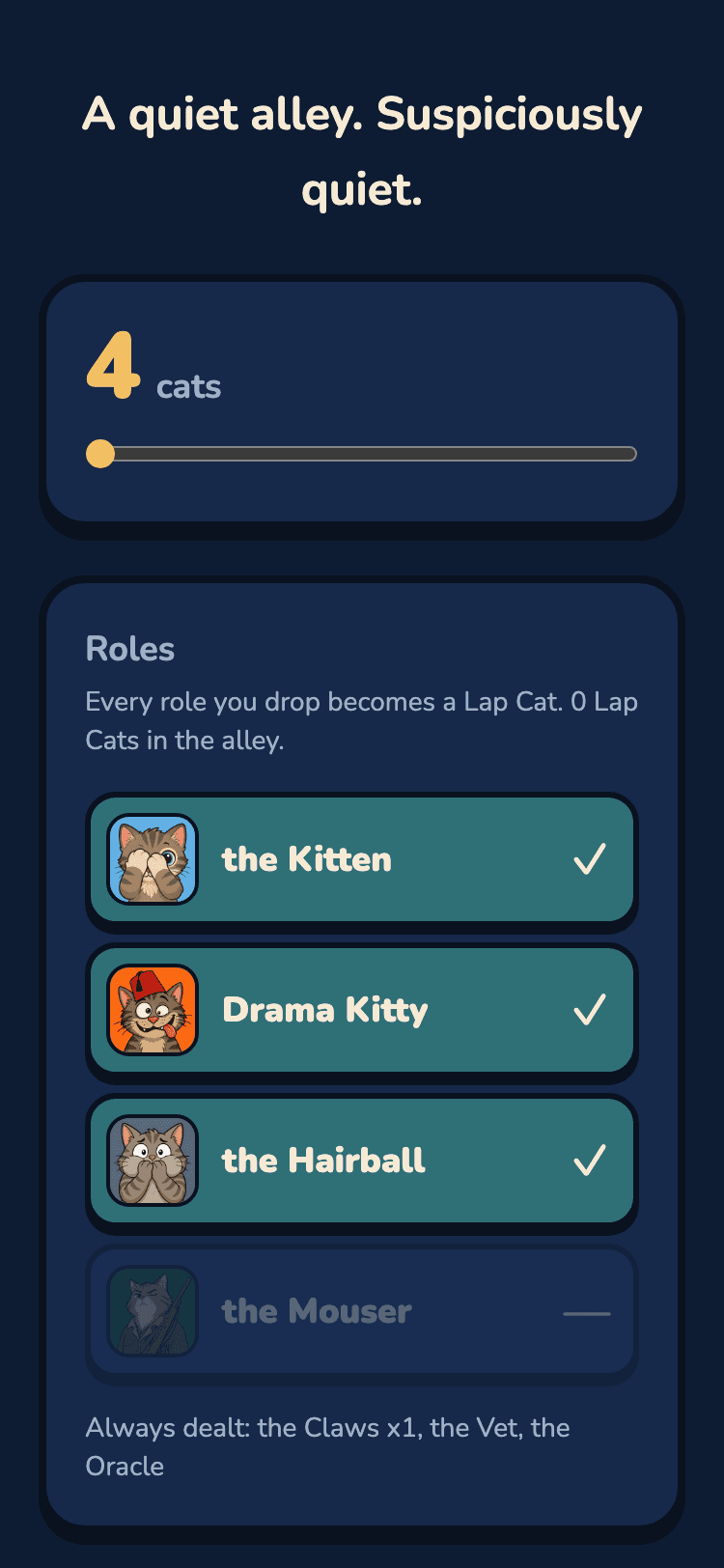
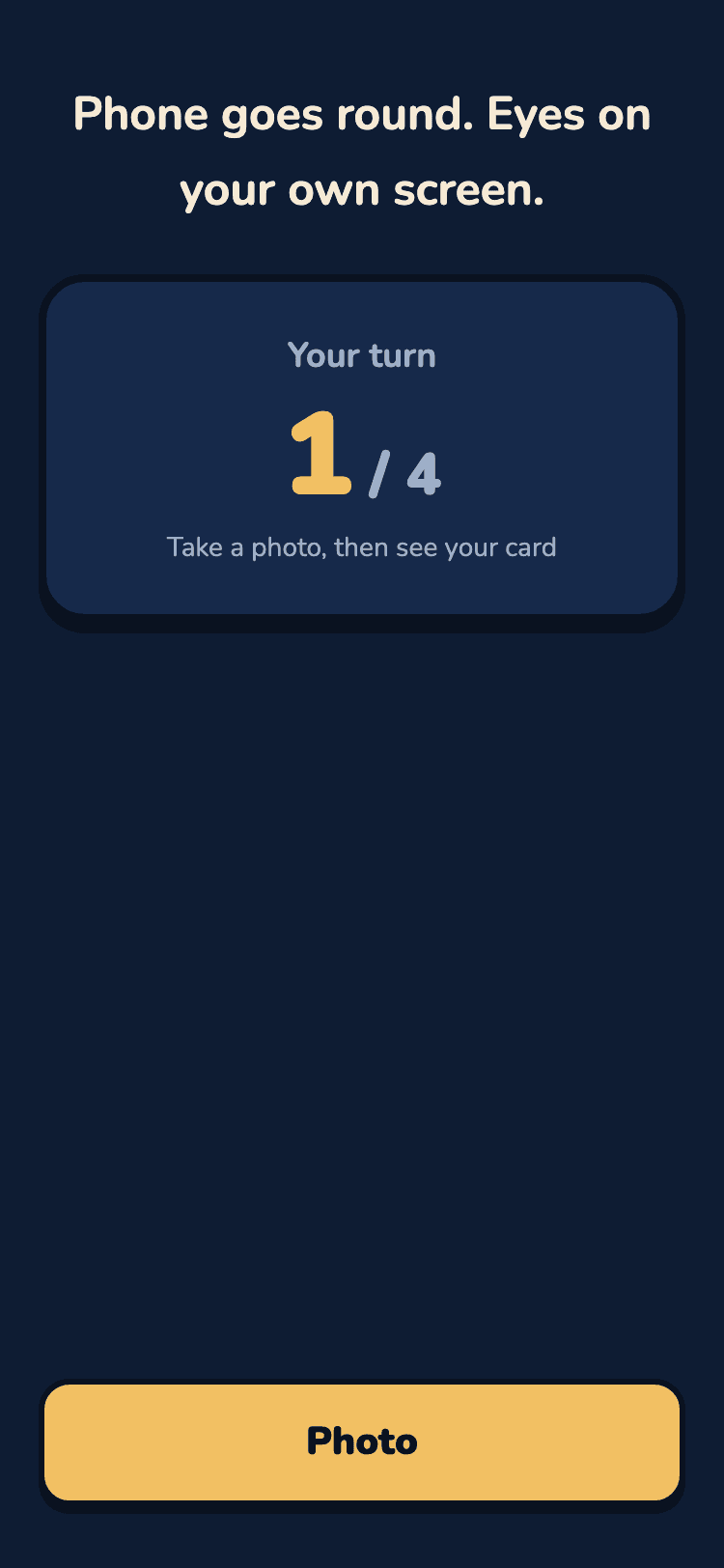
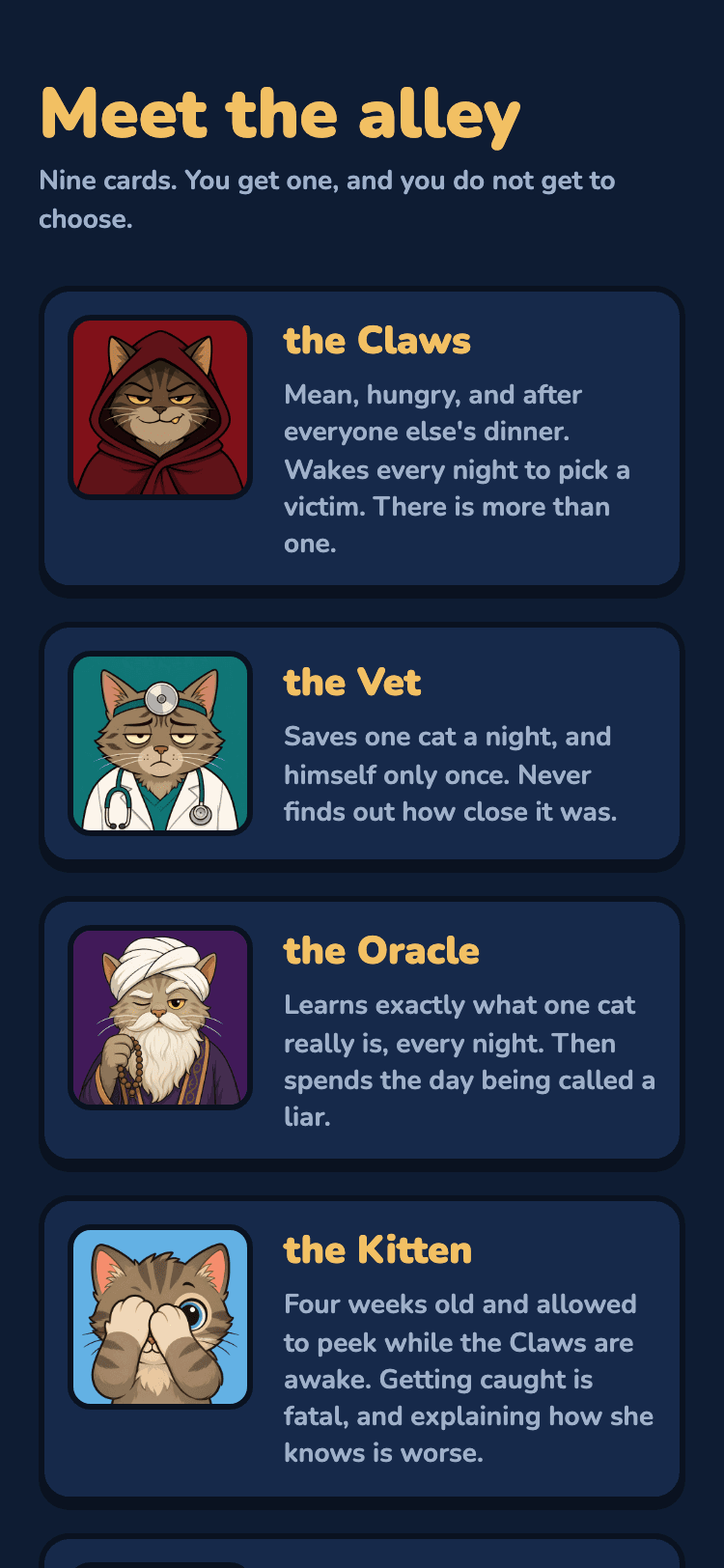
I built a social deduction game, the Mafia kind, where everyone gets a secret role and somebody at the table is lying. The spec came first, checked against the classic rules. Then the build. One phone sits on the table and runs the whole game, from setup to the win screen, telling everyone what to do at every step. Every player is a selfie. Every role is a cat taking itself far too seriously. About two hours after I started, it was playable.
What playing it changed
The first version answered one question: does it run. Playing it on a phone answered the rest. Setup had the phone going round the table more than once, so it became a single pass. The minimum dropped to four players, and the role mix changed so a small table couldn't start a game that was already won. Ten fixes came out of that first playthrough, and each one came from holding the phone and passing it on.
10
fixes from the first playthrough
A narrator for 13 cents
The next day I made a copy to keep, and gave it a voice. The narrator reads the night out loud the way a host would, and the whole script came to 33 lines and three minutes of audio, generated with Mistral's Voxtral for 13 cents. That copy is Cats of the Alley.
33
lines of script
3 min
of audio
13¢
generated with Mistral's Voxtral
What it decided
The other game
went forward
Cats of the Alley
answered its question, and stopped there
It was one of two games I built for that ask. The other one went forward. This one answered its question and stopped there, which is what a proof of concept is for. It still gets played, on one phone, whenever friends come over.
The prototype worked, so I threw it away
Job Studio's logic was proved by hand first, in weeks of running my own job search in Claude. The prototype came after, with one user: me. It took about three weeks, it answered its question, and then I threw it away.
Real enough to use
The prototype's question was whether anyone would use it, starting with me. That takes real behavior, so it got a real backend, with Agno's AgentOS running the AI team behind it and Pipedream connecting it to outside services, and my own career went in as the data. It had to be good enough that I'd choose it over doing the work by hand on a Tuesday night. It was.
The AI team
Agno's AgentOS
Outside services
Pipedream
The data
my own career
The pass line
chosen over the work by hand, on a Tuesday night
Then it met other people
I showed it to a few friends. They used it on their own careers and told me to put it out, which was the prototype's answer: people would use it. It also broke, in three specific ways, the moment it met careers that weren't mine. Those three breaks are what the product was built around, and the Job Studio case study tells that part.
Why I didn't keep it
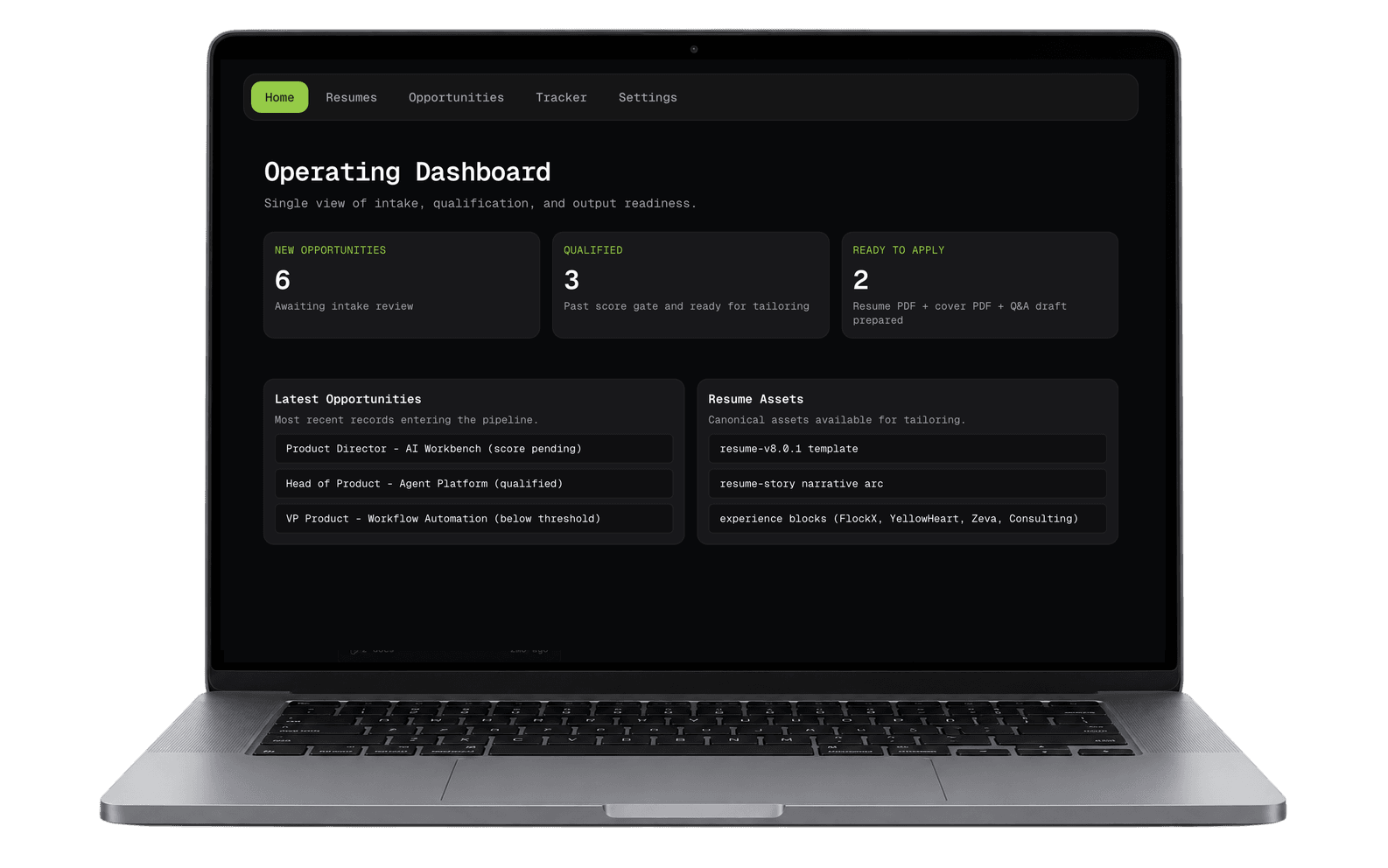
The prototype had done its job, so I didn't carry it forward. I archived it and started the product again, on the platform my AI team builds everything on now. Cagan says prototyping tools are "generally not for building actual products", and the same goes for the prototype itself.
A prototype is built to find out fast. A product is built to hold, and I didn't want it standing on the shortcuts that made the prototype fast.
v0 · archived
Dashboard
v0 · archived
Tracker
Job Studio · live
Rebuilt from scratch
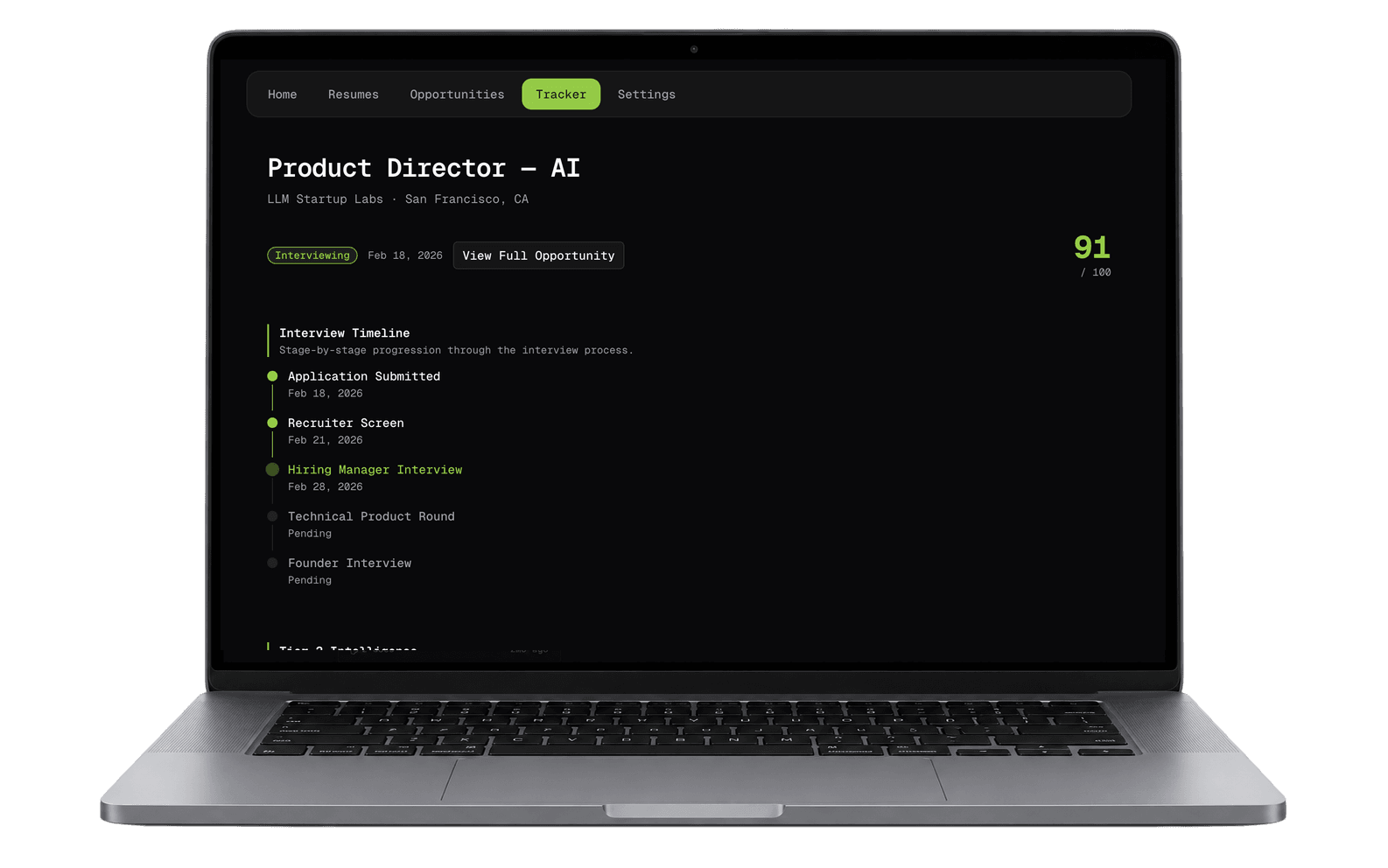
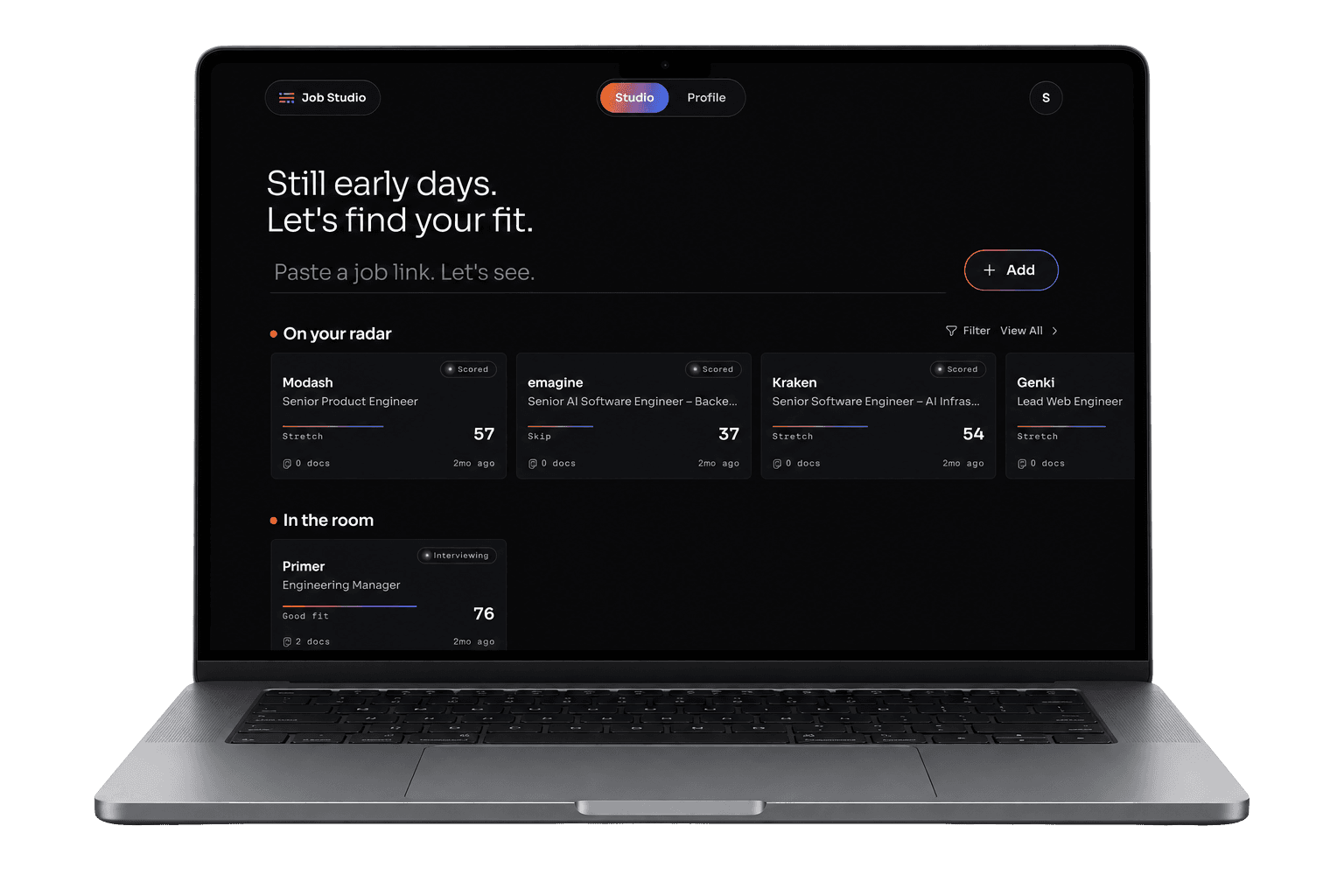
Building the product so it holds is its own story. That's case study 2.
Case study 02
A seat, not a tool.
Read it
The build is the proof now
I learned to check the cheap thing before the expensive thing long before software, and it's still the whole method.
Proof before the run
Before product, I ran a creative shop, and print back then meant film, plate and press. Before every run I was over the proof with a loupe, checking the plates had landed dead-on, because one bad plate scrapped the whole job. The proof was cheap. The run wasn't.
So you checked the cheap one.
Product ran the same way
For most of my twenty-seven years, building software was the expensive run. So an idea got designed and tested as a picture first, and went to engineering once the picture held. I ran product that way in three director seats: federal biometric identity, Web3 ticketing and AI agents. It was right for what building cost.
Then the run got cheap
Once a working build cost about what the picture did, the order flipped. The build is the proof now. I make the cheap working thing first and check it the way I checked a plate. The run, the real product, only starts once it holds.
The change
Then
idea
a picture
test the picture
build
the run
Now
idea
the question and the pass line
a cheap working build
the proof
decide
the run
production
One seat, both ends
Most product teams still split the work. Someone designs the picture, someone else builds the thing, and the proof waits for both.
In my seat one person holds both ends, and AI does the building.
Before you build your next idea
Pick the question first
Write down the one thing that has to be true for the idea to work, the one you're least sure of. The first build exists to answer that, and nothing else yet.
Build only what the question needs
If the question is whether it reads, a rough front end answers it. If it's whether people will use it, it needs real data and real people. Building more than the question needs is building the product before you've decided to.
Draw the line before you look
Decide what a good result looks like before you see the result. Once it's in front of you, almost anything can pass for a yes.
A stopped idea is a result
Plenty of ideas should stop at the first build. That's the method working, and it's the cheapest no you'll ever get.
Give the winner real rails
When an idea earns its way through, build it again, properly. The prototype answered a question, and the product has to hold for years. That's a different job, and it's case study 2.
If you've got more ideas than weeks to test them, that's the part I do.
Start with an hour and one idea.
Tell me what's breaking
One reply, from me, no sequence.