Case study
A seat, not a tool.
Every seat on my product team is AI, except mine
What it took to get AI working as a team, and what the team shipped.
Role
Founder and product lead.
The only human on the team.
Timeline
Since April 2026.
Team
AI in every seat: a business partner in the C-suite, product, engineering, QA, release, and marketing with its writers and dispatcher.
Outcome
Job Studio, live at job-studio.io. 24 releases to production between 4 July and 24 September 2026.
24 releases · 4 Jul 24 Sep
I've been building products for twenty-seven years. Since April I haven't written the code myself. I direct the team that writes it. I decide what gets built and I own every yes. The team does the rest.
The months since went into making the AI behave like a team: owning its work, handing it on cleanly, never grading its own homework, and remembering on Monday what it decided on Friday.
Every seat maps to a role a company already has, so it goes in the way a new hire does. Into a seat that's already there.
The code got faster. The product didn't.
When AI arrives in a company, it usually arrives as a tool: a coding assistant in the editor, a chat window in a browser tab. It writes quickly. It never joins the team.
In METR's 2025 trial, experienced developers expected AI to make them 24% faster. Measured, they were 19% slower, and afterwards they still believed they'd been 20% faster. The tools have improved since.
Experienced developers, with AI
METR, 2025A feeling is still a bad way to measure a team.
AI as a tool
Solved for people
It never writes it the same way twice
There are a dozen right ways to write most code, and a model picks a different one each time you ask. In a prototype that costs nothing. Every proof of concept is a clean afternoon. Production is one codebase for months, and every new way of doing an old thing is one more pattern somebody has to keep alive.
everyone builds to the same patterns
Nobody owns it
A tool has no seat. Whatever it writes belongs to whoever pasted it in, which makes the owner of every change the person who understands it least. Nobody decided it. It just arrived.
someone owns the work
It checks its own work
The model that wrote the code is the one telling you it works. It will say so with a straight face, whether or not it ran a thing. Mine did for months, until I stopped taking its word for it.
someone else checks it
It forgets
Every session starts cold. Close the window and whatever it learned about your product goes with it, so the next session repeats the last one's mistakes with the same confidence.
what gets decided gets written down
None of this is new. Product teams solved all four for people years ago: everyone builds to the same patterns, someone owns the work, someone else checks it, and what gets decided gets written down.
AI never got a seat in that system.
I found that out the slow way.
Every version fixed the last one's blind spot
The rules have been rewritten four times, and every rewrite started with something breaking.
A rule it only has to read is a suggestion
It started with two seats. Product wrote a PRD and dev built it. The rules were one document the dev read before writing anything, and it did read them. Then it took the shortcut whenever the shortcut was quicker, and nothing in the loop was there to notice.
If a machine can check it, a machine should
So I added reviewers: a team of AI auditors checking the code against the rules. They burned two and a half million tokens and the same rules kept breaking. The fix was cheaper and duller. Any rule that could be a search became a search, and the search ran every time.
2.5M
tokens burned by AI reviewers
Every check has to prove it can fail
Then I found out the checks had been lying. The type checker was set to strict and switched off for every module, so 1,026 real errors sat under a green light for months. The checker running the other rules said PASS whenever the failures were only warnings. Now every check carries a planted failure it has to catch. Switching one off takes a written reason, an approval and an expiry date. Nothing gets trusted on its own word.
1,026
real errors under a green light
Judgment needs a pattern to judge against
I asked the team to ease the dev flow and harden the release flow, which was new. The AI on it added a rule of its own: if a review finds no issues, the review has failed. Then it looped until the issues reached zero. In work that's a matter of judgment there's always one more issue, so I ran loop after loop for four or five days while the list of known issues grew. It cost more than ten days of work before I pulled it. Now the checks are mechanical wherever they can be, and anything that needs judgment gets judged against a pattern. Nothing gets judged for the sake of judging.
10+ days
of work lost to a loop
The rules have two readers
Version three ran to 800 lines, written the way one person briefs another. Version four broke that into small rules a machine could check, which suited the machine and nobody else. The version running now splits the job. The checker gets conditions it can test. The team gets the shape of good work, grouped by what it's for, so a builder pulls what applies without knowing a rule number.
Version three
800 lines, written the way one person briefs another.
Version four
Small rules a machine could check.
Now · two readers
The checker
conditions it can test.
The team
the shape of good work, grouped by what it's for.
Every seat has a job, and a line it never crosses
It's a product org. Each seat is a room, a standing role with its own brief, and the work moves between rooms the way it moves between people.
The factory map
human · all other seats AIFounder
names the work, owns every yes
C-suite
Business partner
direction, and what's worth building next
Marketing · CMO
brand, demand and channel, for every property
Writers
draft every word a reader sees
Voice, one per property
each product sounds like itself
Dispatcher
puts approved posts out on six channels
Product · product lead, owner and manager
what gets built, and in what order
who turn a request into buildable items
Dev, BE and FE · head engineer
one item at a time, in its own lane
who write the code
who check every chunk
DevOps · release manager
takes it live
before and after every promotion
Production
Every seat is a role you already have
The map is the org chart. Each seat owns a lane and stays in it. An engineer works in its own copy of the code, on one item, inside a locked list of files it may touch. A writer drafts and never posts. The dispatcher posts and never writes.
An engineer
✓its own copy of the code
✓one item
✓a locked list of files
A writer
✓drafts
✕posts
The dispatcher
✓posts
✕writes
Work moves by handoff
Work starts as a request on the board: what the business needs and how we'll know it worked, with nothing about how to build it. Product walks the flow and cuts it into items, each with a test for every state a user can land in: empty, first run, error, done. Every item names the live code it should look like, so new work follows the patterns already in the tree. What leaves product is already in the shape the engineer reads, with the tests written as Gherkin scenarios, so nothing gets translated between seats and nothing gets lost.
A request on the board
what the business needs and how we'll know it worked
how to build it
Product cuts it into items
a test for every state a user can land in
+ the live code it should look like
The engineer reads it
tests written as Gherkin scenarios
nothing translated · nothing lost
Nobody checks their own work
Product never writes code. An engineer's work merges only on my word. QA gets called at every chunk and again at the close, and it never fixes what it finds. It reports, and the fix goes back to the engineer. Release has a checker of its own, before and after every promotion, so it never signs off its own promotion. Under all of it run the mechanical checks: the tests, a rule checker with a planted failure behind every rule, and guards on every commit and push.
Every session writes itself down
Sessions never compact, the step where a model squeezes its own history to make room. When a session nears the end of its context, it decides what gets logged, writes what it wants its kin to know, and closes. The next session opens clean, with the full written record behind it.
Nears the end of its context
Decides what gets logged
Writes what it wants its kin to know
Closes
The next session opens clean, with the full written record
✕compact
Nothing the team knows lives only in a model's head.
The calls are mine
- I name the work.
- I rule on what QA finds.
- Nothing merges or ships without my yes.
The team does the building, and the calls stay with the one person on the team who answers for them.
This team's first product is live
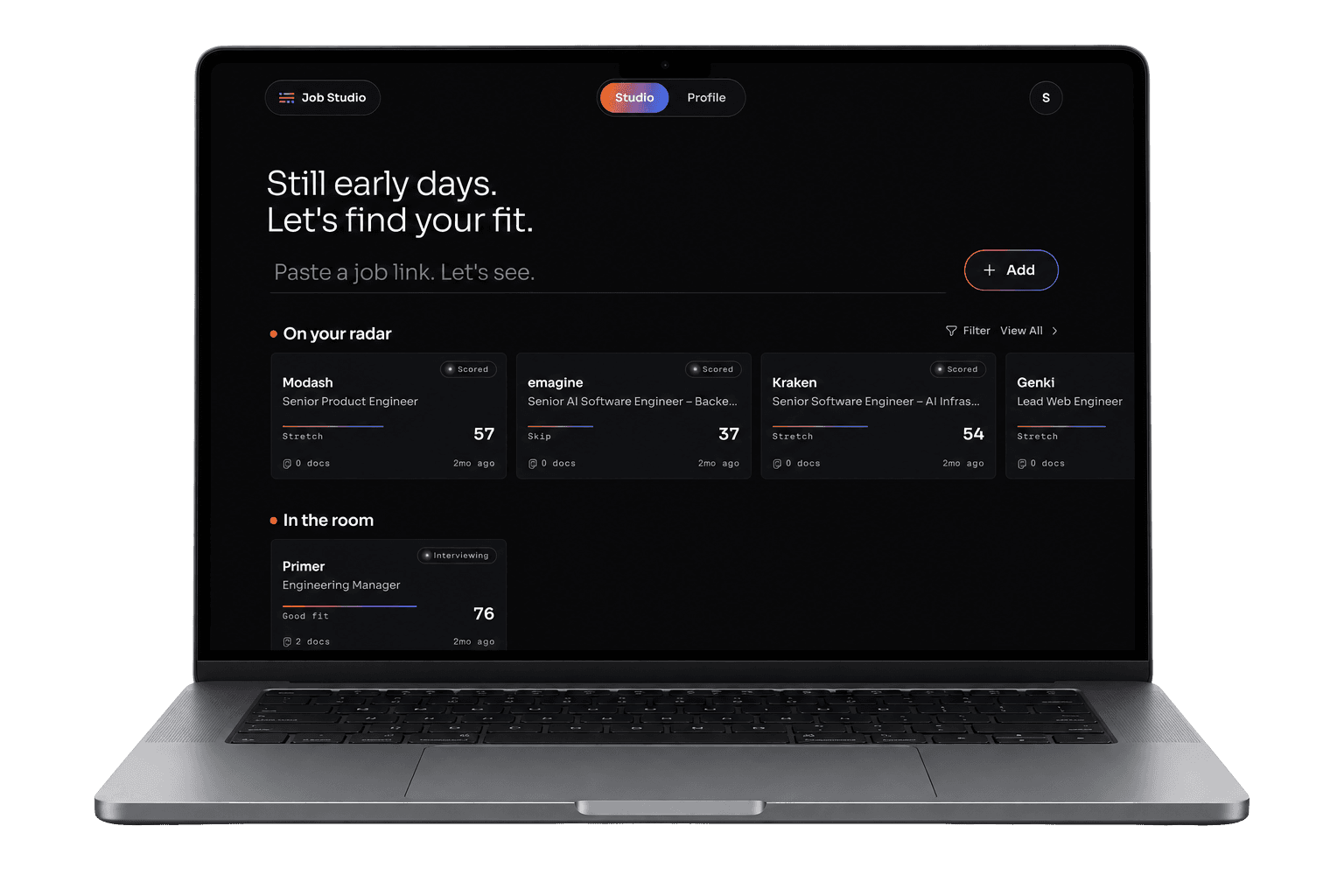
Job Studio is a career studio. You upload a résumé and it comes back as chapters, with an expert on each one. You paste a job link and it scores the job against what you actually want, before it writes a single word on your behalf. It's live.
Here it is, start to finish.
The team from the last three chapters built all of it. The product's own story, and the decisions under it, is a case study of its own.
Case study 01
Job Studio, the case study
Read it
Four apps, one backend, one human
4
apps on one backend, this site among them
20+
services, about a third of them shared across the apps
Per user
an agent team, with an expert on each chapter of their career
~15 · ~130
workflows and API endpoints
~90
database migrations across two databases
~250
functions under unit and smoke tests
40+
rules checked by machine on every commit
Every one of those came off a team with one human on it.
The catch
37
times, hidden in a PDF's metadata
The catch I'd show a client first is a small one. Before a release, the release checker found a private file path of mine hidden 37 times in a PDF's metadata, on none of its pages and nowhere a person would think to look.
Before you put AI on your team
Start with the work that repeats
Pick the work somebody on your team does by hand every week. You already know what good looks like there, so you can check it, and a check is where everything else starts.
Give every seat a check and an owner
An AI seat with nothing checking it is a liability on a timer. Every one gets a check that runs without anyone asking, and a named person on your side who owns the yes.
Put it in seats your people already know
Most teams already have someone deciding what gets built and someone making sure it works before it ships. The AI takes seats like those, next to your people, with a lane each. Nobody has to learn a new org chart.
Every check has to make the work faster
Checks breed. Before a new one goes in, it answers one question: does this make the work faster, or does it only add a check? If it only adds a check, it stays out. I learned that one by losing ten days.
Build it to run without me
When I leave, your people should be able to open every part of it, run it again and change it without calling me. The rules are written down, the work lives on a board, and every session leaves its notes. That's what you keep.
Deciding what's worth building is a different job. Case study 3 is how I do that one.
Case study 03
Deciding is the expensive part.
Read it
If you're somewhere between a proof of concept that took an afternoon and software that still has to work on Tuesday, that's the gap I close.
Start with an hour and one problem.
Tell me what's breaking
One reply, from me, no sequence.